EgoMyo: Physical Hand State Estimation from Egocentric Video and Wrist Electromyography



* Equal contribution · † Corresponding author · dcszj@tsinghua.edu.cn
Abstract
Physical hand interaction depends on configuration, contact, and force, yet nearly identical appearances can conceal different contact states and exerted forces. We therefore formulate physical hand state estimation from egocentric video and wrist surface electromyography (sEMG), combining visual geometry with neuromuscular evidence to jointly recover these coupled components.
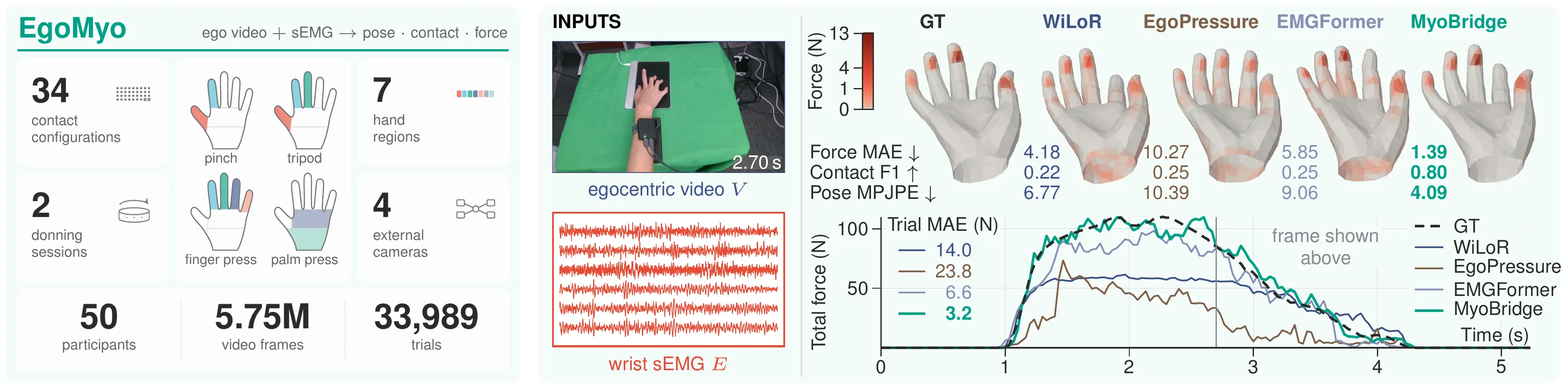
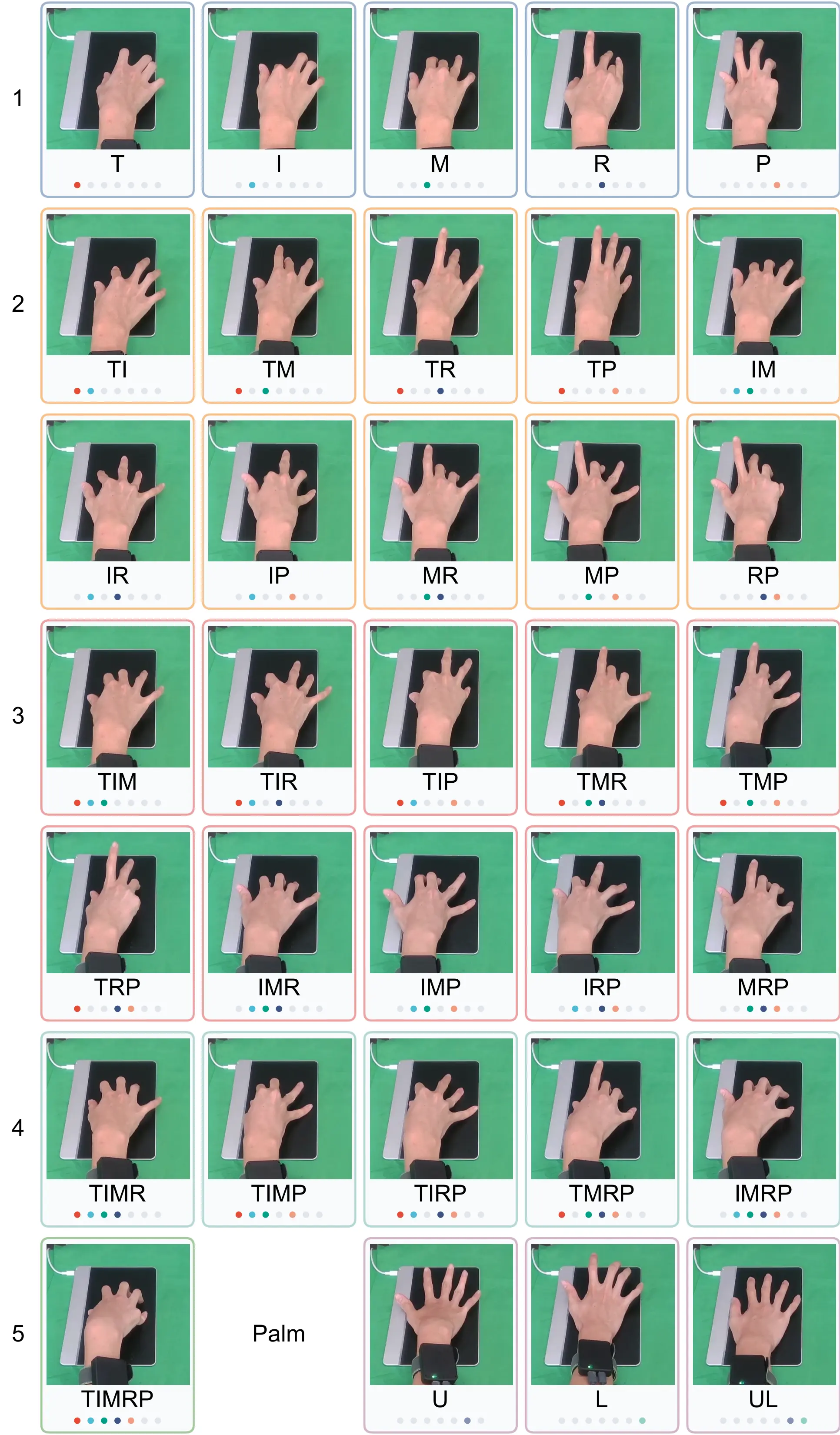
To support this task, we introduce EgoMyo, a benchmark spanning 5.75M video frames, 50 participants, 34 contact configurations, and repeated donnings, synchronizing these inputs with 3D hand pose and with contact and normal force registered onto the hand surface from bare-hand pressure. Controlled analysis reveals that vision resolves spatial structure while sEMG better estimates force magnitude, that sEMG's gains concentrate in regions where vision is least reliable, and that contact localization limits force accuracy.
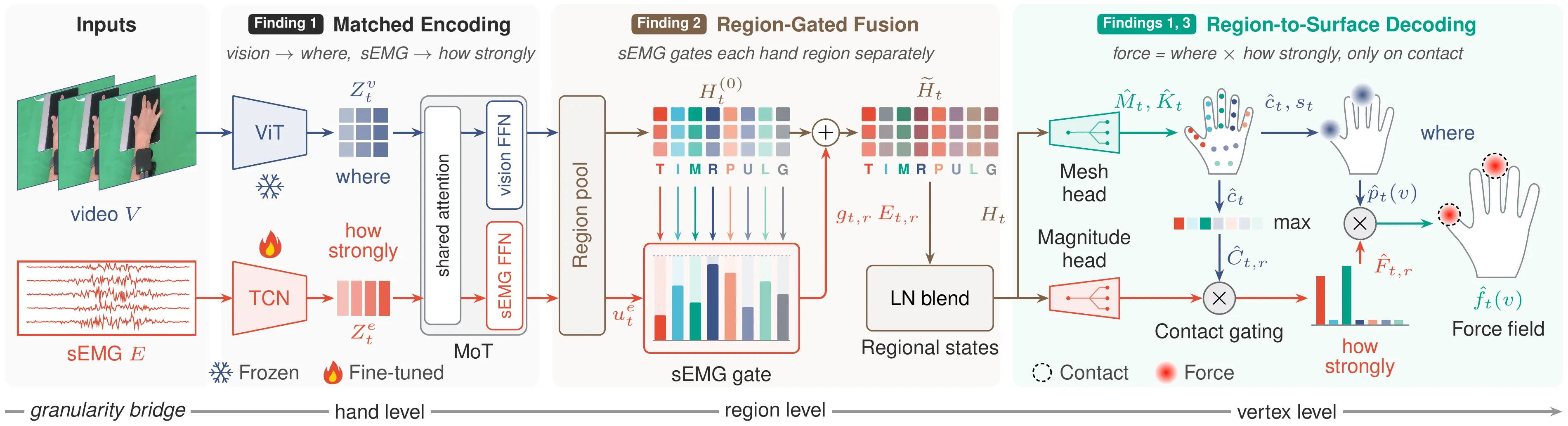
Guided by these findings, we propose MyoBridge, which makes the hand region the unit of vision–sEMG fusion, lets each region gate its own share of sEMG, and distributes regional force magnitudes only over predicted contact vertices at inference. On held-out trials, MyoBridge reduces pose and force error by 39.8% and 18.5% over the strongest baseline and achieves the lowest pose error on unseen sessions and subjects.
MyoBridge Demonstrations
Compare how MyoBridge and the baselines estimate contact and force from egocentric video and 18-channel wrist sEMG.
Recorded trial 2
MyoBridge
MyoBridge combines vision and muscle activity for each hand region, then distributes each region’s estimated force across the mesh vertices predicted to be in contact.
Benchmark Results
The three test splits hold out trials, wristband fittings, or participants to assess pose, contact, and force estimation.
Method Comparison
Loading benchmark results…
Values are mean ± standard deviation. V denotes egocentric video and E denotes wrist sEMG. MPJPE and PVE measure joint and mesh vertex position error, respectively. Higher F1 and lower position and force errors are better.
Capture and Annotations
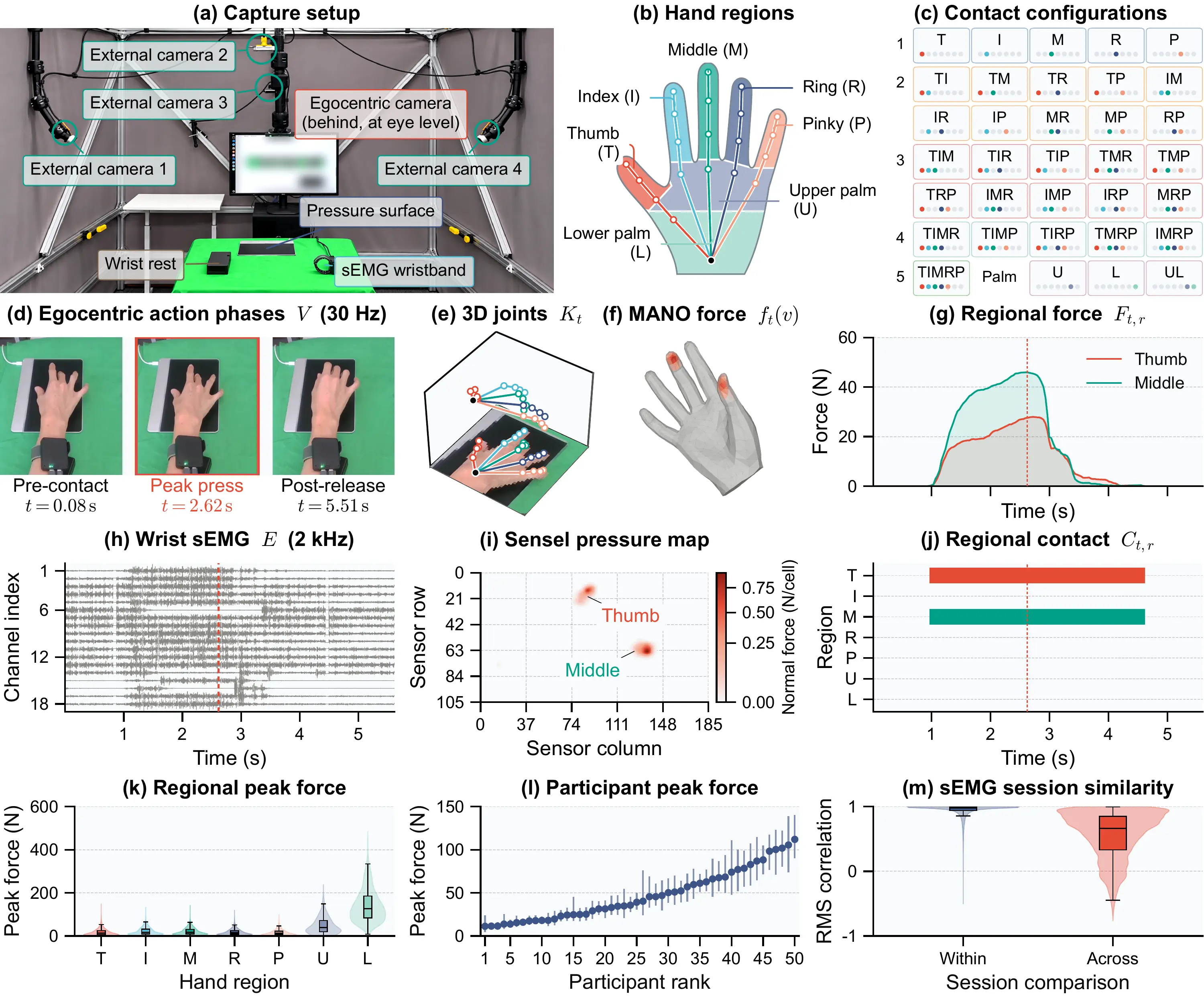
Participants fitted the wristband twice for each hand. The protocol called for five repetitions of all 34 contact configurations after each fitting.

Synchronized Multimodal Trials
Choose a trial and use the shared timeline to explore its synchronized video, hand mesh, muscle activity, and pressure data.
Loading trial…
Egocentric Video
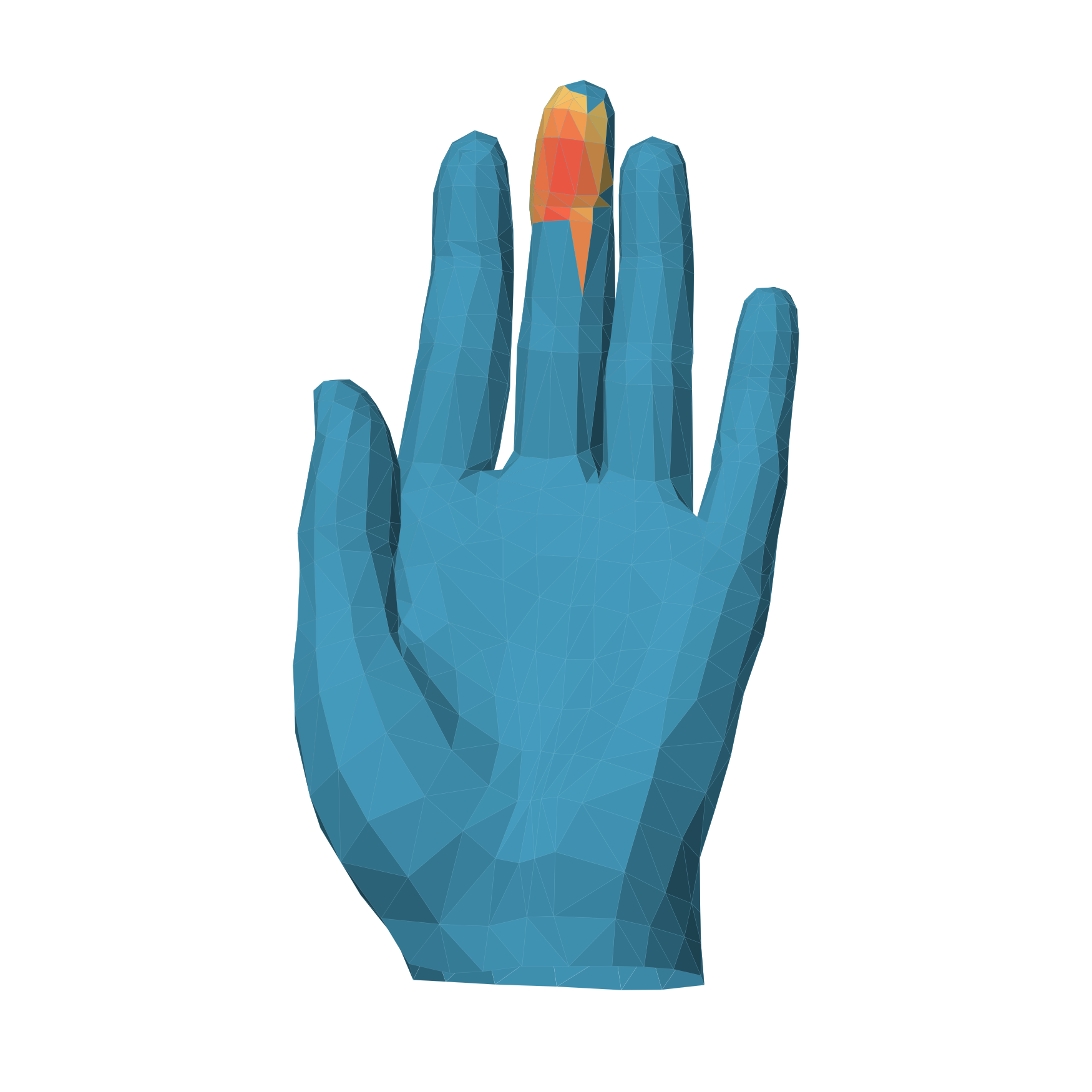
MANO Surface Force
Wrist sEMG
18 normalized channelsTrial times
Pressure Map
Regional Force
NSeven-region sum—
Dataset at a Glance
Each trial pairs egocentric video and wrist sEMG with hand pose, contact, and force on a shared timeline.
Egocentric video and sEMG
Video, frame timestamps, 18-channel ADC samples, and sample indices.
Pose and hand surface
21 joints in 3D and UVD coordinates, MANO meshes, and validity flags.
Pressure and contact
Pressure matrices, seven-region force estimates, and per-face contact data.
Calibration and timing
Camera calibration, frame timestamps, and trial intervals.
Download EgoMyo
Download one package per participant and hand. Files are grouped by wristband session, action, and trial, with calibration, timestamps, and validity flags.
Hugging FaceExample package layout
subject_<id>/
  DATASET.json
  DATA_FORMAT.md
  calibration/cameras/
  dataset/subject_<id>/
    session_01/action_01/trial_01/
      ego/       Video and timestamps
      emg/       18-channel sEMG
      force/     Pressure and regional force
      pose/      3D / UVD pose
      contact/   MANO and contact
      trial_info.json
  read_dataset.py